But how can we do this under capitalism? After his climate negotiators stonewalled calls for binding limits on CO2 emissions at Copenhagen, Cancun, Cape Town and Doha, President Obama is now trying to salvage his environmental "legacy" by ordering his EPA to impose "tough" new emissions limits on existing power plants, especially coal-fired plants. But this won't salvage his legacy or, more importantly, his daughters' futures because how much difference would it make, really, if every coal-fired power plant in the U.S. shut down tomorrow when U.S. coal producers are free to export their coal to China, which they are doing, and when China is building another coal-fired power plan every week? The atmosphere doesn't care where the coal is burned. It only cares how much is burned.
Yet how could Obama tell American mining companies to stop mining coal? This would be tantamount to socialism. But if we do not stop mining and burning coal, capitalist freedom and private property is the least we'll have to worry about. Same with Obama's "tough" new fuel economy standards. In August 2012 Obama boasted that his new Corporate Average Fuel Economy (CAFE) standards would "double fuel efficiency" over the next 13 years to 54.5 miles per gallon by 2025, up from 28.6 mpg at present - cutting vehicle CO2 emissions in half, so helping enormously to "save the planet." But as the Center for Biological Diversity and other critics have noted, Obama was lying, as usual.
First, his so-called "tough" new CAFE standards were so full of loopholes, negotiated with Detroit, that they actually encourage more gas-guzzling, not less. That's because the standards are based on a sliding scale according to "vehicle footprints" - the bigger the car, the less mileage it has to get to meet its "standard." So in fact Obama's "tough" standards are (surprise) custom designed to promote what Detroit does best - produce giant Sequoias, mountainous Denalis, Sierras, Yukons, Tundras and Ticonderogas, Ram Chargers and Ford F series luxury trucks, grossly obese Cadillac Escalades, soccer-kid Suburbans, even 8,000 (!) pound Ford Excursions - and let these gross gas hogs meet the "fleet standard." These cars and "light" trucks are among the biggest selling vehicles in America today (GM's Sierra is #1) and they get worse gas mileage than American cars and trucks half a century ago. Cadillac's current Escalade gets worse mileage than its chrome bedecked tail fin-festooned land yachts of the mid-1950s! Little wonder Detroit applauded Obama's new CAFE standards instead of damning them as usual. Secondly, what would it matter even if Obama's new CAFE standards actually did double fleet mileage - when American and global vehicle fleets are growing exponentially?
In 1950 Americans had one car for every three people. Today we have 1.2 cars for every American. In 1950 when there were about 2.6 billion humans on the planet, there were 53 million cars on the world's roads - about one for every 50 persons. Today, there are 7 billion people but more than 1 billion cars and industry forecasters expect there will be 2 to 2.5 billion cars on the world's roads by mid-century. China alone is expected to have a billion. So, at the end of the day, incremental half measures like CAFE standards can't stop rising GHG missions. Barring some technical miracle, the only way to cut vehicle emissions is to just stop making them - drastically suppress vehicle production, especially of the worst gas hogs.
In theory, Obama could simply order GM to stop building its humongous gas guzzlers and switch to producing small economy cars. After all, the federal government owns the company! But of course, how could he do any such thing? Detroit lives by the mantra "big car big profit, small car small profit." Since Detroit has never been able to compete against the Japanese and Germans in the small car market, which is already glutted and nearly profitless everywhere, such an order would only doom GM to failure, if not bankruptcy (again) and throw masses of workers onto the unemployment lines. So given capitalism, Obama is, in fact, powerless. He's locked in to promoting the endless growth of vehicle production, even of the worst polluters - and lying about it all to the public to try to patch up his pathetic "legacy." And yet, if we don't suppress vehicle production, how can we stop rising CO2 emissions?
In the wake of the failure of climate negotiators from Kyoto to Doha to agree on binding limits on GHG emissions, exasperated British climate scientists Kevin Anderson and Alice Bows at the Tyndall Centre, Britain's leading climate change research center, wrote in September 2012 that we need an entirely new paradigm:
Government policies must "radically change" if "dangerous" climate change is to be avoided "We urgently need to acknowledge that the development needs of many countries leave the rich western nations with little choice but to immediately and severely curb their greenhouse gas emissions... [The] misguided belief that commitments to avoid warming of 2°C can still be realized with incremental adjustments to economic incentives. A carbon tax here, a little emissions trading there and the odd voluntary agreement thrown in for good measure will not be sufficient ... long-term end-point targets (for example, 80% by 2050) have no scientific basis. What governs future global temperatures and other adverse climate impacts are the emissions from yesterday, today and those released in the next few years."
And not just scientists. In its latest world energy forecast released on November 12, 2012, the International Energy Agency (IEA) warns that despite the bonanza of fossil fuels now made possible by fracking, horizontal and deepwater drilling, we can't consume them if we want to save the humans: "The climate goal of limiting global warming to 2°C is becoming more difficult and costly with each year that passes... no more than one-third of proven reserves of fossil fuels can be consumed prior to 2050 if the world is to achieve the 2°C goal..." Of course the science could be wrong about this. But so far climate scientists have consistently underestimated the speed and ferocity of global warming, and even prominent climate change deniers have folded their cards.
Still, it's one thing for James Hansen or Bill McKibben to say we need to "leave the coal in the hole, the oil in the soil, the gas under the grass," to call for "severe curbs" in GHG emissions - in the abstract. But think about what this means in our capitalist economy. Most of us, even passionate environmental activists, don't really want to face up to the economic implications of the science we defend.
That's why, if you listen to environmentalists like Bill McKibben for example, you will get the impression that global warming is mainly driven by fossi- fuel-powered electric power plants, so if we just "switch to renewables" this will solve the main problem and we can carry on with life more or less as we do now. Indeed, "green capitalism" enthusiasts like Thomas Friedman and the union-backed "green jobs" lobby look to renewable energy, electric cars and such as "the next great engine of industrial growth" - the perfect win-win solution. This is a not a solution. This is a delusion: greenhouse gasses are produced across the economy not just by power plants. Globally, fossil-fuel-powered electricity generation accounts for 17% of GHG emissions, heating accounts for 5%, miscellaneous "other" fuel combustion 8.6%, industry 14.7%, industrial processes another 4.3%, transportation 14.3%, agriculture 13.6%, land use changes (mainly deforestation) 12.2%. This means, for a start, that even if we immediately replaced every fossil-fuel-powered electric generating plant on the planet with 100% renewable solar, wind and water power, this would only reduce global GHG emissions by around 17%.
What this means is that, far from launching a new green-energy-powered "industrial growth" boom, barring some tech-fix miracle, the only way to impose "immediate and severe curbs" on fossil fuel production/consumption would be to impose an EMERGENCY CONTRACTION in the industrialized countries: drastically retrench and in some cases shut down industries, even entire sectors, across the economy and around the planet - not just fossil fuel producers but all the industries that consume them and produce GHG emissions - autos, trucking, aircraft, airlines, shipping and cruise lines, construction, chemicals, plastics, synthetic fabrics, cosmetics, synthetic fiber and fabrics, synthetic fertilizer and agribusiness CAFO operations.
Of course, no one wants to hear this because, given capitalism, this would unavoidably mean mass bankruptcies, global economic collapse, depression and mass unemployment around the world. That's why in April 2013, in laying the political groundwork for his approval of the XL pipeline in some form, President Obama said "the politics of this are tough." The earth's temperature probably isn't the "number one concern" for workers who haven't seen a raise in a decade; have an underwater mortgage; are spending $40 to fill their gas tank, can't afford a hybrid car; and face other challenges." Obama wants to save the planet but given capitalism his "number one concern" has to be growing the economy, growing jobs. Given capitalism - today, tomorrow, next year and every year - economic growth will always be the overriding priority ... till we barrel right off the cliff to collapse.
The necessity of denial and delusion
There's no technical solution to this problem and no market solution either. In a very few cases - electricity generation is the main one - a broad shift to renewables could indeed sharply reduce fossil fuel emissions in that sector. But if we just use "clean" "green" energy to power more growth, consume ever more natural resources, then we solve nothing and would still be headed to collapse. Producing millions of electric cars instead of millions of gasoline-powered cars, as I explained elsewhere, would be just as ecologically destructive and polluting, if in somewhat different ways, even if they were all run on solar power.
Substituting biofuels for fossil fuels in transportation just creates different but no less environmentally-destructive problems: converting farm land to raise biofuel feedstock pits food production against fuels. Converting rainforests, peatlands, savannas or grasslands to produce biofuels releases more CO2 into the atmosphere than the fossil fuels they replace and accelerates species extinction. More industrial farming means more demand for water, synthetic fertilizers and pesticides. And so on. Cap and trade schemes can't cut fossil fuel emissions because business understands, even if some environmentalists do not, that "dematerialization" is a fantasy, that there's no win-win tech solution, that capping emissions means cutting growth. Since cutting growth is unacceptable to business, labor and governments, cap and trade has been abandoned everywhere.
Carbon taxes can't stop global warming either because they do not cap emissions. That's why fossil fuel execs like Rex Tillerson, CEO of ExxonMobil (the largest private oil company in the world) and Paul Anderson, CEO of Duke Energy (the largest electric utility in the U.S.) support carbon taxes. They understand that carbon taxes would add something to the cost of doing business, like other taxes, but they pose no limit, no "cap" on growth. ExxonMobil predicts that, carbon tax or no carbon tax, by 2040 global demand for energy is going to grow by 35%, 65% in the developing world and nearly all of this is going to be supplied by fossil fuels. ExxonMobil is not looking to "leave the oil in the soil" as a favor to Bill McKibben and the humans. ExxonMobil is looking to pump it and burn it all as fast as possible to enrich its shareholders.
Hansen, McKibben, Obama - and most of us really - don't want to face up to the economic implications of the need to put the brakes on growth and fossil fuel-based overconsumption. We all "need" to live in denial, and believe in delusions that carbon taxes or some tech fix will save us because we all know that capitalism has to grow or we'll all be out of work. And the thought of replacing capitalism seems so impossible, especially given the powers arrayed against change. But what's the alternative? In the not-so-distant future, this is all going to come to a screeching halt one way or another - either we seize hold of this out-of-control locomotive, or we ride this train right off the cliff to collapse.
Emergency Contraction or Global Ecological Collapse?
If there's no market mechanism to stop plundering the planet then, again, what alternative is there but to impose an emergency contraction on resource consumption?
This doesn't mean we would have to de-industrialize and go back to riding horses and living in log cabins. But it does mean that we would have to abandon the "consumer economy" - shut down all kinds of unnecessary, wasteful and polluting industries from junkfood to cruise ships, disposable Pampers to disposable H&M clothes, disposable IKEA furniture, endless new model cars, phones, electronic games, the lot. Plus all the banking, advertising, junk mail, most retail, etc. We would have completely redesign production to replace "fast junk food" with healthy, nutritious, fresh "slow food," replace "fast fashion" with "slow fashion," bring back mending, alterations and local tailors and shoe repairmen. We would have to completely redesign production of appliances, electronics, housewares, furniture and so on to be as durable and long-lived as possible. Bring back appliance repairmen and such. We would have to abolish the throwaway disposables industries, the packaging and plastic bag industrial complex, bring back refillable bottles and the like. We would have to design and build housing to last for centuries, to be as energy efficient as possible, to be reconfigurable, and shareable. We would have to vastly expand public transportation to curb vehicle use but also build those we do need to last and be shareable like Zipcar or Paris' municipally-owned "Autolib" shared electric cars.
These are the sorts of things we would have to do if we really want to stop overconsumption and save the world. All these changes are simple, self-evident, no great technical challenge. They just require a completely different kind of economy, an economy geared to producing what we need while conserving resources for future generations of humans and for other species with which we share this planet.
The spectre of eco-democratic revolution
Economic systems come and go. Capitalism has had a 300 year run. The question is: will humanity stand by and let the world be destroyed to save the profit system?
That outcome depends to a great extent on whether we on the left can answer that question "what's your alternative?" with a compelling and plausible vision of an eco-socialist civilization. We have our work cut out for us. But what gives the growing global eco-socialist movement an edge in this ideological struggle is that capitalism has no solution to the ecological crisis, no way to put the brakes on collapse, because its only answer to every problem is more of the same growth that's killing us.
"History" was supposed to have "ended" with the fall of communism and the triumph of capitalism two decades ago. Yet today, history is very much alive and it is, ironically, capitalism itself which is being challenged more broadly than ever and found wanting for solutions.
Today, we are very much living in one of those pivotal world-changing moments in history. Indeed, it is no exaggeration to say that this is the most critical moment in human history.
We may be fast approaching the precipice of ecological collapse, but the means to derail this train wreck are in the making as, around the world, struggles against the destruction of nature, against dams, against pollution, against overdevelopment, against the siting of chemical plants and power plants, against predatory resource extraction, against the imposition of GMOs, against privatization of remaining common lands, water and public services, against capitalist unemployment and precarité are growing and building momentum.
Today we are riding a swelling wave of near simultaneous global mass democratic "awakening," an almost global mass uprising. This global insurrection is still in its infancy, still unsure of its future, but its radical democratic instincts are, I believe, humanity's last best hope.
Let's make history!



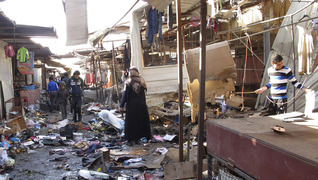
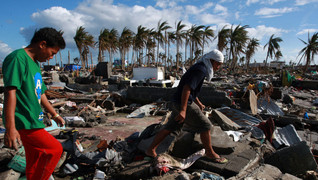
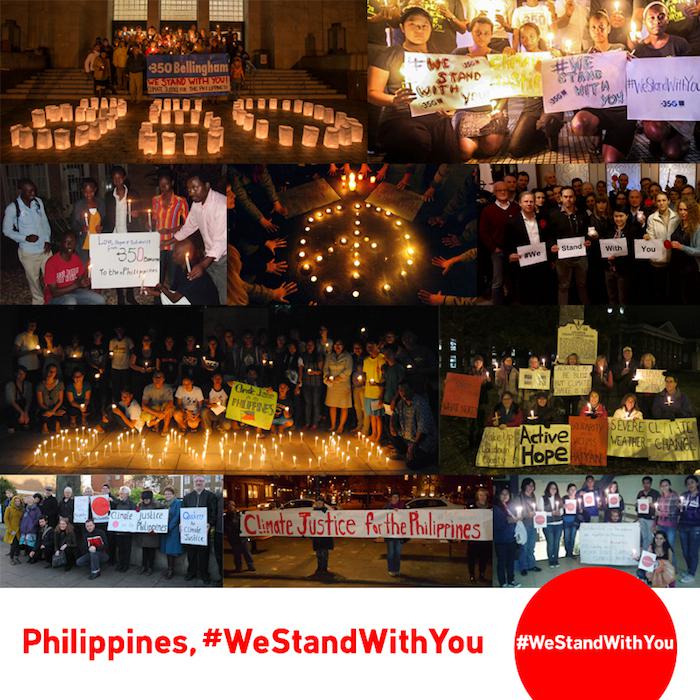


 uper Typhoon Haiyan has sent a chill through the global nervous system. Thousands dead. Weather scientists in shock. Lives destroyed. The greatest typhoon to touch land in recorded history brings with it more than total destruction. It ups the level of urgency for a new economic paradigm ... one that puts the planet first. Radical economist Richard Smith shows us a way out of the "


