31 March 22
Live on the homepage now!
Reader Supported News

Swedish media reported that four of Vladimir Putin’s jets flew over Baltic towards the island of Gotland.
TV4, Expressen and Aftonbladet all reported the formation was two Sukhoi Su-24 bombers and two Sukhoi Su-27 fighters.
The bombers were the ones reportedly armed with the nuclear weaponry.
Stockholm’s military has not yet confirmed if the planes carried a nuclear payload.
The warplanes reportedly took off from the Russian airbase in the enclave of Kaliningrad during the incident on March 2.
Sources told TV4 the move is believed to have been a deliberate attempt to intimidate Sweden.
Swedish JAS 39 Gripen jets were sent to intercept the planes - and they were in their airspace for around one minute.
Stockholm confirmed an interception earlier this month, but the reports about the jets being armed with nuclear weaponry only emerged on Wednesday.
A statement from the Swedish armed forces said: “On 2 March, four Russian fighter aircraft violated Swedish airspace. The Swedish air force conducted an operation with JAS 39 Gripen aircraft of the rapid readiness unit, which documented and photographed the incident.
“This demonstrates that our readiness is good. We were on site to secure Sweden’s borders and territorial integrity. We are in full control of the situation”, says Air Force Commander Carl-Johan Edström.
The Swedish airspace was violated by two Russian SU 27 and two Russian SU 24. The incident was brief and took place east of Gotland, out at sea.
“With the current situation as backdrop, we take this incident very seriously. Russia’s conduct is unprofessional and irresponsible.”
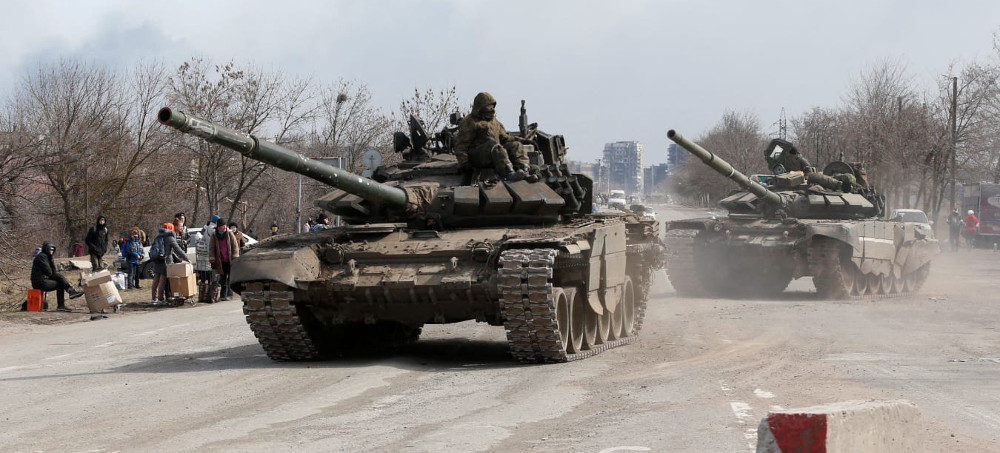 Russian tanks in Ukraine. (photo: Reuters)
A young Ukrainian mother is speaking out about what may be the first rape case connected to the 2022 invasion to go before The Hague.
In an interview with The Times of London published Tuesday, the woman, identified only by the pseudonym Natalya, says she still has not been able to bring herself to tell her son that his father was murdered by the Russian soldiers.
“We cannot bury him, we can’t get to the village, because the village is still occupied,” the 33-year-old mother said of the family’s home in Brovary, a suburb of Kyiv.
It was there that she says Russian soldiers arrived on the morning of March 9 and, despite a white sheet hanging from the family’s home to indicate there were no military targets. They killed the family’s dog before gunning down Natalya’s husband a few hours later.
“I heard a single shot, the sounds of the gate opening and then the sound of footsteps in the house,” she was quoted telling the Times. “I cried out, ‘Where is my husband?’ then I looked outside and I saw him on the ground by the gate. This younger guy pulled gun to my head and said: ‘I shot your husband because he’s a Nazi.’”
After that, she said, things became only more harrowing. While her son sat sheltering in a dark boiler room at the home, the soldiers set their sights on her.
“[One of the Russian soldiers] said ‘You’d better shut up or I’ll get your child and show him his mother’s brains spread around the house,’” she said. “He told me to take my clothes off. Then they both raped me one after the other. They didn’t care that my son was in the boiler room crying. They told me to go shut him up and come back. All the time they held the gun by my head and taunted me, saying ‘How do you think she sucks it? Shall we kill her or keep her alive?’”
They brutalized her again less than a half hour later, she said, but she and her son managed to flee when both the soldiers got “so drunk” they passed out.
“While I was opening the gate, my son was standing next to his father’s body but it was dark and he did not understand it was his father. He said ‘Will we get shot the same as this man here?’” she said.
Ukraine’s prosecutor general, Iryna Venediktova, announced last week that Ukrainian authorities had identified one of Natalya’s rapists, and that a warrant was out for his arrest.
“We will find every villain and make him answer to the fullest extent of the law,” Venediktova wrote on Facebook.
Natalya said the Russian commander who raped her had introduced himself to her by name, and she later managed to track him down on social media. There are unconfirmed rumors that he was ultimately killed by Ukrainian forces, but, she said, “I still do not know for sure if it is true.”
While Natalya’s story stands out because she was able to identify one of her attackers, reports of rape by Russian marauders have multiplied since the Kremlin launched its all-out war against Ukraine on Feb. 24. Ukrainian Foreign Minister Dmytro Kuleba has said he intends to bring such cases before the International Criminal Court.
And while evidence of such war-time rapes is typically difficult to collect, Ukrainian authorities say Russian troops have openly talked about systemic rape in intercepted phone calls.
Ukraine’s Security Service released audio this past weekend of a man it identifies as a Russian soldier telling a female acquaintance about troops killing civilians and preying on women in an occupied village.
“The guys in the neighboring village raped a grown woman and a 16-year-old girl,” he can be heard saying.
Authorities did not reveal where the Russian soldier captured in the recording was based.
In another audio clip shared earlier this month by Anton Gerashchenko, an adviser to Ukraine’s interior minister, a man identified as a Russian soldier laughingly tells a friend about one of his comrades boasting about executing civilians and committing rapes.
“‘And they will give me a medal for that,’” he recalled the soldier joking.
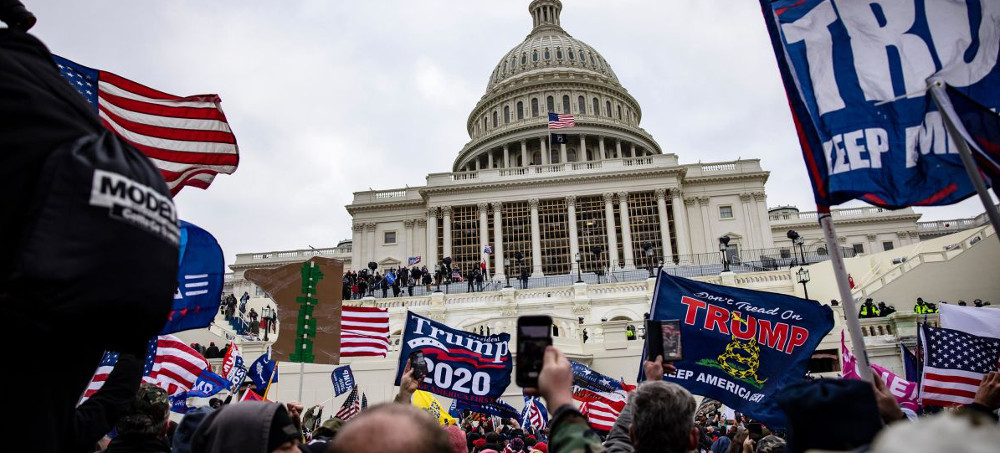 Trump's call to Republican senator Mike Lee should have been reflected in presidential call log on day of Capitol attack but wasn't (photo: Getty)
Trump’s call to Republican senator should have been reflected in presidential call log on day of Capitol attack but wasn’t
The former president called the phone of a Republican senator, Mike Lee, with a number recorded as 202-395-0000, a placeholder number that shows up when a call is incoming from a number of White House department phones, the sources said.
The number corresponds to an official White House phone and the call was placed by Donald Trump himself, which means the call should have been recorded in the internal presidential call log that was turned over to the House select committee investigating the Capitol attack.
Trump’s call to Lee was reported at the time, as well as its omission from the call log, by the Washington Post and CBS. But the origin of the call as coming from an official White House phone, which has not been previously reported, raises the prospect of tampering or deletion by Trump White House officials.
It also appears to mark perhaps the most serious violation of the Presidential Records Act – the statute that mandates preservation of White House records pertaining to a president’s official duties – by the Trump White House concerning January 6 records to date.
A spokesperson for Trump did not immediately respond to a request for comment.
Trump called Lee at 2.26pm on January 6 through the official 202-395-0000 White House number, according to call detail records reviewed by the Guardian and confirmation by the two sources, who spoke on the condition of anonymity to discuss sensitive matters.
The call was notable as Trump mistakenly dialed Lee thinking it was the number for Republican Senator Tommy Tuberville. Lee passed the phone to Tuberville, who told Trump Mike Pence had just been removed from the Senate chamber as rioters stormed the Capitol.
But Trump’s call to Lee was not recorded in either the presidential daily diary or the presidential call log – a problem because even though entries in the daily diary are discretionary, according to several current and former White House officials, the call log is not.
The presidential daily diary is a retrospective record of the president’s day produced by aides in the Oval Office, who have some sway to determine whether a particular event was significant enough to warrant its inclusion, the officials said.
But the presidential call log, typically generated from data recorded when calls are placed by the White House operators, is supposed to be a comprehensive record of all incoming and outgoing calls involving the president through White House channels, the officials said.
The fact that Trump’s call to Lee was routed through an official White House phone with a 202-395 prefix – either through a landline in the West Wing, the White House residence or a “work” cellphone – means details of that call should have been on the call log.
The only instance where a call might not be reflected on the unclassified presidential call log, the officials said, would be if the call was classified, which would seem to be unlikely in the case of the call to Lee. The absence of Trump’s call to Lee suggests a serious breach in protocol and possible manipulation, the officials said.
It was not immediately clear how a Trump White House official might obfuscate or tamper with the presidential call log, or who might have the authority to make such manipulations.
Trump’s calls on January 6 might not have been recorded in the presidential call log if he used his personal phone or the cellphones of aides, the officials said, and Trump sometimes called people with the cellphone of his then White House deputy chief of staff, Dan Scavino.
But multiple current and former White House officials have noted that a copy of the call log – alongside the president’s daily schedule and the presidential line-by-line document – might be provided to Oval Office operations to help compile the presidential daily diary.
That could lead to a situation where records are vulnerable to tampering, since the presidential daily diary and call log needs approval by a senior White House official before they can be sent to the White House office of records management, the officials said.
And by the time of January 6, two former Trump White House officials said, there was scope for political interference in records preservation, with no White House staff secretary formally appointed after Derek Lyons’ departure on 18 December.
The White House Communications Agency has also not been immune to political influence, the select committee revealed last year, when it found evidence the agency produced a letter that was intended to be used to pressure states to decertify Joe Biden’s election win.
Trump’s call to Lee was not the only call missing from an unexplained, seven-hour gap in the presidential call log that day. Trump, for instance, also connected with House minority leader Kevin McCarthy as the Capitol attack unfolded.
The presidential daily diary and presidential call log were turned over to the select committee by the National Archives after the supreme court refused a last-ditch request from Trump to block the release of White House documents to the panel.
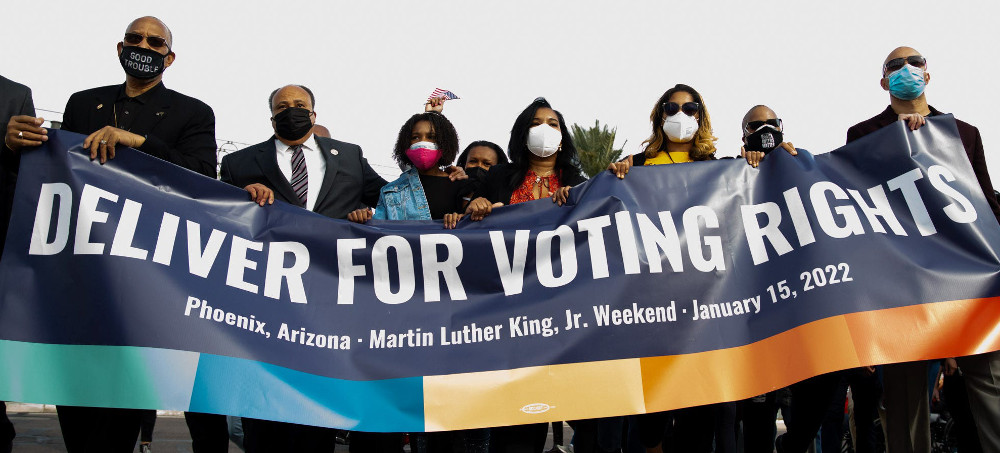 Martin Luther King III and his family lead the Deliver for Voting Rights march in Phoenix on Jan 15, 2022. (photo: Zac BonDurant/Arizona Republic)
Arizona’s Republican governor has signed a bill requiring voters to prove their citizenship to vote in a presidential election, drawing fierce opposition from voting rights advocates who say it risks affecting some 200,000 people
The bill also requires anyone newly registering to vote to provide proof of their address.
The Legislature’s own lawyers say much of the measure is unconstitutional, directly contradicts a recent Supreme Court decision and is likely to be thrown out in court. Still, voting rights advocates worry the bill is an attempt to get back in front of the now more conservative Supreme Court.
"Election integrity means counting every lawful vote and prohibiting any attempt to illegally cast a vote,” Ducey said in a letter explaining his decision to sign the bill.
He called the bill "a balanced approach that honors Arizona’s history of making voting accessible without sacrificing security in our elections.”
Rep. Jake Hoffman, who developed the bill along with the conservative Heritage Foundation, said the measure is about eliminating opportunities for fraud, though cases of noncitizens voting are extremely rare.
The precise impact is a matter of dispute. Ducey, Hoffman and other supporters say it affects only the roughly 31,500 voters who have not shown proof of citizenship. Voting advocates say it's vague and could go much farther, affecting hundreds of thousands of people who haven't recently updated their voter registration or driver's license.
“Arizona’s way out on a limb here,” said Jon Sherman, litigation director for the Fair Elections Center. “The provisions in this bill are not really found anywhere in the country.”
Arizona is the only state that requires voters to prove their citizenship when they register, a provision adopted in a 2004 ballot measure known as Proposition 200. Voters can demonstrate citizenship by providing a driver’s license or tribal ID number, or they can attach a copy of a birth certificate, passport or naturalization documents. Voters already registered at the time were grandfathered in.
In a challenge to Proposition 200, the U.S. Supreme Court ruled in 2013 that Arizona can adopt its own eligibility criteria for state elections but must accept a federal voter registration form for federal elections. The federal form requires voters to attest under penalty of perjury that they are citizens, but unlike the state form, it does not require them to provide documentary proof. The state has tried unsuccessfully to get the federal form changed.
The ruling created a class of voters who can vote only for president, U.S. House and U.S. Senate known as “federal only voters.” There are 31,500 people currently registered that way, according to the Arizona Secretary of State’s Office.
There is no evidence that the existence of federal only voters has allowed noncitizens to illegally vote, but Republican skeptics have nonetheless worked aggressively to crack down.
The bill would prohibit federal-only voters from voting by mail or voting for president. It would require state election officials to cross check registration information with various government databases.
The bill also requires people to include proof of their address with new voter registrations. Election officials say that’s complicated and unnecessary because addresses are verified at the time of voting. Voting rights advocates say it will make registration drives much more complicated, especially among people who don't have an Arizona driver's license or state ID with an up-to-date address, such as college students, Native Americans and seniors who no longer drive.
In a further complication, the bill would take effect 90 days after the end of the legislative session, which is likely to fall between the primary and general elections. Affected voters could vote legally in the Aug. 2 primary, would get notified their registration was at risk of cancellation if they didn’t prove their citizenship, and they’d have until Oct. 11 to fix the issue or miss their chance to vote in the general election.
Republican supporters say they plan to pass another bill delaying the start until after the 2022 election, but nothing has yet been introduced.
Sam Almy, a data analyst who consults for Democratic campaigns, said his analysis of voter registration records found just under 220,000 voters who have not updated their registration since 2004, when Proposition 200 passed. The group skews heavily toward registered Republicans, older people and those who consistently vote.
Of those affected, 71% have voted in all of the last three general elections. Forty-five percent are registered Republicans, 36% are Democrats and the rest are independents. Half are at least 65 years old and nearly 90% are at least 50.
The Arizona Motor Vehicle Division has verified that applicants for driver’s licenses and state identification cards are legally in the United States since 1996 but does not verify that they’re citizens, said Bill Lamoreaux, an agency spokesman. There are about 192,000 people with a state license or ID issued before 1996, he said.
 Apple and Meta handed over user data to hackers. (photo: AP)
Both companies received phony emergency data requests
Law enforcement officials often request data from social platforms in connection with criminal investigations, allowing them to obtain information about the owner of a specific online account. While these requests require a subpoena or search warrant signed by a judge, emergency data requests don’t — and are intended for cases that involve life-threatening situations.
Fake emergency data requests are becoming increasingly common, as explained in a recent report from Krebs on Security. During an attack, hackers must first gain access to a police department’s email systems. The hackers can then forge an emergency data request that describes the potential danger of not having the requested data sent over right away, all while assuming the identity of a law enforcement official. According to Krebs, some hackers are selling access to government emails online, specifically with the purpose of targeting social platforms with fake emergency data requests.
As Krebs notes, the majority of bad actors carrying out these fake requests are actually teenagers — and according to Bloomberg, cybersecurity researchers believe the teen mastermind behind the Lapsus$ hacking group could be involved in conducting this type of scam. London police have since arrested seven teens in connection with the group.
But last year’s string of attacks may have been performed by the members of a cybercriminal group called Recursion Team. Although the group has disbanded, some of them have joined Lapsus$ with different names. Officials involved in the investigation told Bloomberg that hackers accessed the accounts of law enforcement agencies in multiple countries and targeted many companies over the course of several months starting in January 2021.
“We review every data request for legal sufficiency and use advanced systems and processes to validate law enforcement requests and detect abuse,” Andy Stone, Meta’s policy and communications director, said in an emailed statement to The Verge. “We block known compromised accounts from making requests and work with law enforcement to respond to incidents involving suspected fraudulent requests, as we have done in this case.”
When asked for comment, Apple directed The Verge to its law enforcement guidelines, which state: “If a government or law enforcement agency seeks customer data in response to an Emergency Government … Law Enforcement Information Request, a supervisor for the government or law enforcement agent who submitted the Emergency Government … Law Enforcement Information Request may be contacted and asked to confirm to Apple that the emergency request was legitimate.”
Meta and Apple aren’t the only known companies affected by fake emergency data requests. Bloomberg says hackers also contacted Snap with a forged request, but it’s not clear if the company followed through. Krebs on Security’s report also includes a confirmation from Discord that the platform gave away information in response to one of these fake requests.
“This tactic poses a significant threat across the tech industry,” Peter Day, Discord’s group manager for corporate communications said in an emailed statement to The Verge. “We are continuously investing in our Trust … Safety capabilities to address emerging issues like this one.”
Snap didn’t immediately respond to a request for comment from The Verge.
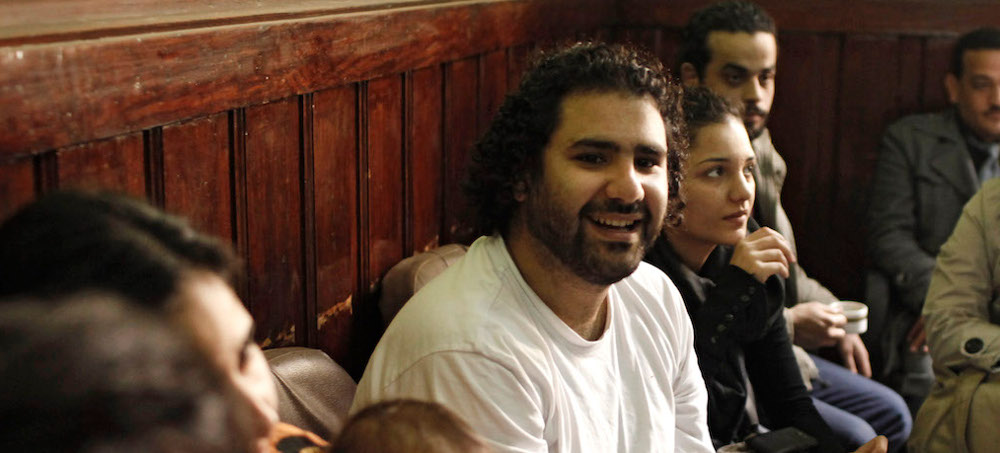 Alaa Abd el-Fattah sits with his family and supporters in a waiting room at Cairo's High Court prior to a hearing on March 26, 2013 in Cairo, Egypt. (photo: Ed Giles/Getty)
Alaa Abd el-Fattah is a leading Egyptian dissident, today held in a maximum security jail in Cairo. His prison writings express the living thought of the Egyptian revolution, defying the Sisi government’s attempt to extinguish it.
There, invoking a common description of Gaza as a sort of open-air prison, he writes — with typical care neither to romanticize nor trivialize — that in life, it is prisoners who best understand freedom. Only because this sentiment flows from Alaa’s own pen does it seem acceptable to suggest that even from a jail cell in Egypt, he has a freedom of mind that many in the West do not possess even outside of one.
The Canadian writer Naomi Klein writes a foreword to a new US edition of You Have Not Yet Been Defeated in which she makes the assertion — hard to contest — that in this book you are reading living history. Klein also touches upon the point that perhaps the most important word in the book is the first one — the opening to its superb, vital title: You.
Alaa Abd el-Fattah is today kept in the maximum security Torah prison, just outside of Cairo. One of the most prominent thinkers and writers of the Egyptian revolution, Alaa comes from a political family, and has the unfortunate distinction of having been imprisoned or persecuted in each phase of Egypt’s recent political history: under Hosni Mubarak, during the brief period of elected Muslim Brotherhood rule, and — in the backlash after its failure — the present, probably most brutal government, under former army general Abdel Fattah al-Sisi.
From his cells, Alaa has done a monumental service to people anywhere concerned with the destiny of democracy, as he sketches the contours of political change at its most urgent. He has lived, and thus writes of, circumstances where physical violence is so acute and political expression so oppressed that you cannot be made to shy from the urgency of reform by the frowns of polite society or the false prophets of false equivalence.
Alaa’s political references fluently range from South Africa and the African National Congress to the monopolistic pitfalls of Silicon Valley and startup financing. For him, these global ideas clearly sit — as they often do not — side by side his own struggle for democracy at home.
Not Giving Up on Humanity
In an early episode in the book, the reader is offered a telling moment in the midst of revolution. A low-income Coptic family, never served by the Egyptian state, are persuaded to compromise their religious observation upon the death of their son, so that an autopsy might be performed, police brutality proven, and justice done. Alaa describes the act of transcendence in such a moment; the poor and unjustly bereaved are persuaded to believe in a justice and a politics that has never been present — and to place the fragile promise that this might indeed be possible above the tradition and faith that is all they have ever had.
Alaa’s large heart and eloquence allow him to outline the meaning of such a moment with a clarity that most writers, journalists, and political thinkers could never have done. Indeed, it seems that his Western counterparts often earn their platforms and pay precisely on condition that they could never do so.
In other moments, Alaa recounts the anger of a game of football between another new intake of dissidents into the prison. The match is played to an undercurrent of resentments and uncertainties based on who has been in which prison, for how long, and who has been tortured on his way there. In this instance like so many, Alaa shows his colossal determination always to insist on humanity, with all its blemishes. By his service of simply caring enough to write it all, he gives the reader a chance to process and act on the information and analysis, without the trauma of those forced to experience such brutality.
To say that You Have Not Yet Been Defeated is an important book is not to do it justice. Again, that opening word — You — is needed to give this book the impact it deserves. It would be impossible to read this work only as the sort of cultural product that some political and even notionally radical writing can take on, but it would also be a sin to read it and not at least be fortified in steadfastness against the frowns of a polite-but-corrupted society that still resists the imperative of material change in either Egypt or among its Western backers.
Ever self-aware, Alaa contrasts the relative privilege and lesser tortures reserved for known dissidents such as he, compared to the poor, or the people of Sinai, or many of those from the Muslim Brotherhood. Among the lesser forms of torture he notes are smear campaigns, trivialization of serious issues, and character assassination. If it would be wrong to directly compare the suffering of those in jail to those outside, it would be equally mistaken not to draw the parallel with the methods of soft repression inside the West’s managed democracies, and to steel yourself with Alaa’s fortitude.
In keeping with this global calling, Alaa’s train of thought is relentlessly universal. He references Vodafone’s infamous decision to cut communications to protesters during key moments in the run-up to the Egyptian revolution (while using footage from the revolution to advertise the service they had supposedly provided). But he is also realistic in his assessment that — in true “banality of evil” style — whoever took the decision or drew up the contract allowing Hosni Mubarak’s government such power may not even have been aware that they had done so. Alaa references Vodafone’s political lobbying for “competitive” tax policy in the United Kingdom, pouring rightful scorn on the idea of corporations as politically neutral bodies. But more than that, this is one of many examples demonstrating how deeply Alaa’s words cut right to the heart of the Western world, which he often seems to grasp more fully from a Cairo jail than many political commentators in London or Manhattan.
Closer to home, Palestine is a consistent feature of the essays, along with an awareness that — particularly in Gaza — Palestinian liberty has been sacrificed to the Israeli government even more assertively than other Arab populations were subjugated beneath their own despots and cronies. Clearly Alaa must be released, and the Sisi government — which enjoys no internal legitimacy but much US funding — cannot go on. But Alaa asserts more directly than most how integrally these goals now also relate to progress in ending Israeli apartheid in Palestine, which even in the West ever more people are coming to understand as the knot from which so much regional tyranny unravels.
Western Guilt
Sisi is doubtless the principal culprit in the detention of Alaa. But in reading his essays, it is hard not to consider two Western figures who have been pivotal to the situation that has seen Alaa, his sisters, and up to a hundred thousand other Egyptians made into political prisoners.
First among them is Barack Obama, with his administration’s decision not to declare the 2013 killing spree at Rabaa Square — when hundreds and possibly a thousand Muslim Brotherhood members were massacred by the Sisi government — as part of the coup it so clearly was. To do so would have legally barred the United States from continuing the billions of dollars of military aid that still flows to Cairo, and which helps lock in the violence by which Sisi wrested Egypt from democracy back to dictatorship.
If we are generous, Obama can be granted some allowances in that those few precious months of Egyptian democracy were chaotic, marked also by state violence. During them, the Muslim Brotherhood foolishly did much to undermine the democratic revolution they had just helped win. This should not obscure the role of the tens of billions of dollars given by the United Arab Emirates and Saudi Arabia to help Sisi and his goons take power, nor the blind eye Obama turned toward this. But perhaps, just maybe, something of that sinister label “complex” can at least be applied to his approach.
No such mitigating factor exists for French president Emmanuel Macron, who by a callousness that can only rightly be called evil saw fit as recently as 2020 to pin a Légion d’Honneur to Sisi’s bloodstained breast. Macron has many Bonapartist tendencies and vanities, but in no other instance has this slight politician truly been so small, nor shown himself so lowly an opponent of democracy anywhere on earth, particularly where practiced by either Arabs or Muslims.
Without indulging the increasingly common EU practice of raising white, European lives to higher values, the tyranny in Macron’s blessing of Sisi was only compounded — to the fury of many across the Alps — by his ability also to overlook the Sisi government’s torture and murder of Italian labor researcher, Giulio Regeni. Macron got a large-ish ($4.5 billion) order of fighter jets from Sisi for his troubles, but the total shaming of the entire French state, and its highest “honor,” might have been thought to be worth more.
Solidarity
Although Alaa doesn’t spare the Muslim Brotherhood criticism for its failure to immediately pull down the structures of the Mubarak government, he refuses to throw it under the bus of despotism. Whatever their obvious political differences, he honors the lives of thousands in the Brotherhood who were killed as the Sisi government brutalized its way into office and then labeled the group a terrorist organization. He does not — as nobody should — obfuscate the fact that the horror of Rabaa Square is the monstrosity from which at some point Egypt and its democracy will have to be rebuilt.
It is this determination, and Alaa’s determination to stand with everyone in pursuit of Egyptian democracy — the poor, the Muslim, the Coptic Christian, the trade unionist, the urban liberal — that gives his words their force. In them he creates a political map that can be replicated elsewhere, particularly in places where politics is not throttled by denial of rights to the extent that Egyptians suffer. Here, often it would only take a fraction of Alaa’s courage and — equally important — clarity of thought.
In an essay toward the end of the collection, Alaa draws strength from learning of the Palestinian resistance to Israeli attacks in the summer of 2021. With his signature inability to disconnect his experience from the outside world, he writes that “the tragedy I am living is but my share of yours.”
The line is a beautiful invocation of perhaps the most recurring theme in You Have Not Yet Been Defeated; namely, the assertion that indignity and injustice cannot be confined only to those who suffer it, without also inducing guilt, shame, and even a weakening for the perpetrator, the complicit, the silent and indifferent.
Wherever they are now to be read, his essays will have a liberating effect that has to be internalized, perhaps particularly in Western readers, who must now return this favor, to Alaa and to Egypt. Free them all.
 A steel mill on Indiana's Grand Calumet River. (photo: Getty)
Now, a new report from the Environmental Integrity Project (EIP) finds the country has fallen far short of that goal. In fact, about half of the nation’s lakes and rivers are too polluted for swimming, fishing or drinking.
“The Clean Water Act should be celebrated on its 50th birthday for making America’s waterways significantly cleaner,” EIP Executive Director Eric Schaeffer said in a press release announcing the report. “However, we need more funding, stronger enforcement, and better control of farm runoff to clean up waters that are still polluted after half a century. Let’s give EPA and states the tools they need to finish the job – we owe that much to our children and to future generations.”
The report was based on reports that states are required to submit under the Clean Water Act on the pollution levels of their rivers, streams, lakes and estuaries. According to the most recent reports, more than half of the lakes and rivers are considered “impaired,” meaning that they fall short of standards for fishing, swimming, aquatic life and drinking.
Specifically, around 51 percent of rivers and streams and 55 percent of lake acres are considered impaired, The Hill reported. Further, 26 percent of estuary miles are also impaired.
The Clean Water Act was a landmark legislative achievement when it was passed in 1972. It promised to end the discharge of all pollutants into navigable waters by 1985, according to the press release. However, it has fallen short of that goal for several reasons, according to the report.
- The act has strong controls for pollution pumped directly into waterways from factories or sewage plants but not for indirect pollution such as agricultural runoff from factory farms.
- The Environmental Protection Agency (EPA) has dragged its feet in updating industry-specific technology-based limits for water pollution control systems. By 2022, two-thirds of these industry-specific limits had not been updated in more than 30 years.
- Budget cuts have hampered the ability of the EPA and state agencies to enforce the law.
- Permit requirements are poorly enforced.
- Total Maximum Daily Loads, a kind of pollution control plan, are insufficient.
- There are problems effectively managing watersheds that cover two or more states.
The report also broke down pollution by state. Indiana has the most miles of rivers and streams too impaired for swimming and recreation.
“Indiana’s waters have benefited from the Clean Water Act, but unfortunately, they also illustrate some of the gaps in the law,” Dr. Indra Frank, Environmental Health … Water Policy Director for the Hoosier Environmental Council, said in the press release. “We have seen persistent, unresolved impairments, especially for E coli bacteria in our rivers and streams, in part from industrial agricultural runoff. And we have also seen examples of Clean Water Act permits used to send water contaminated with coal-ash into our rivers. We need to halt pollution like this.”
Florida, meanwhile, had the most lake acres impaired for swimming and aquatic life.
“Florida’s toxic-algae crisis is the direct result of lax enforcement of phosphorus and nitrogen pollution limits in cleanup plans required by the Clean Water Act,” Friends of the Everglades Executive Director Eve Samples said in the press release. “Because these limits rely on voluntary ‘best management practices’ and a presumption of compliance, agricultural polluters regularly exceed phosphorus runoff limits while dodging responsibility — leading to harmful algal blooms in Florida’s lakes, rivers, estuaries, and even on saltwater beaches.”
The report did propose several solutions that range from making sure that the EPA and other agencies carry out their duties under the existing law to strengthening the act with new legislation to control runoff pollution.
This last is particularly important because agricultural runoff and other indirect pollution sources are the leading causes of waterway pollution.
“Factory-style animal production has become an industry with a massive waste disposal problem and should be regulated like other large industries,” the study authors wrote.
Special Coverage: Ukraine, A Historic Resistance
READ MORE
Follow us on facebook and twitter!
PO Box 2043 / Citrus Heights, CA 95611