Search This Blog

Translate

Blog Archive

Middleboro Review 2

NEW CONTENT MOVED TO MIDDLEBORO REVIEW 2

Toyota

Since the Dilly, Dally, Delay & Stall Law Firms are adding their billable hours, the Toyota U.S.A. and Route 44 Toyota posts have been separated here:

Route 44 Toyota Sold Me A Lemon


Showing posts sorted by relevance for query dirty coal. Sort by date Show all posts

Saturday, February 21, 2009

Coal Ash: Dirty Coal's Dirty Little Secret

When the topic of energy is discussed, there is a truism about certain forms of energy being cheaper than renewable energy (wind, solar, geo-thermal, tidal/wave and so on) because of subsidies, hidden preferential treatment, loan guarantees (such as ones being demanded by nuclear), or, as in the case of Dirty Coal, the exemption from the monetary consequences of environmental devastation caused by Mountain Top Removal, air pollution, the slipshod disposal of ash and spills.
.
Of course Dirty Coal is cheap when you can blow up mountains, push the debris into streams, contaminate drinking water, allow ash spills to sterilize ecosystems, allow soot and mercury to foul the air, and generous campaign contributions have assured no corrective action.
.
A BostonGlobe editorial offered --
.
COAL is the cheapest source of electricity. One major reason why is that mining companies and coal-burning utilities have managed to pass many of its health and environmental costs - from the dust miners breathe to greenhouse gases - onto society at large.
.
In Massachusetts, where fly ash from the Salem power plant once contaminated the Lake Wenham water supply of Beverly, ash that is not reused in concrete production or other beneficial applications ends up in lined and covered landfills. Even in this state, though, there is no law mandating safe disposal. A bill co-sponsored by Representatives Lori Ehrlich of Marblehead and Mary Grant of Beverly would do so.
.
Kudos are owed Reps. Ehrlich and Grant for stepping forward for much-needed legislation to protect the Commonwealth from the hazards created by plants such as the coal-burning Salem power plant.
.
The Center for Public Integrity offered a report, Coal Ash: The Hidden Story, that includes a map of Ash Country positioning waste ponds and landfills nationwide. The report is worth the read in its totality.
.
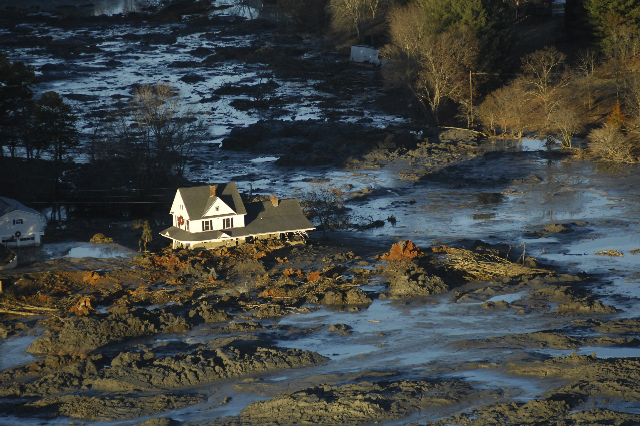
Just as the TVA destroyed Harriman, Tennessee with a massive coal sludge spill on December 22, 2008, ...the U.S. coal industry engages in a massive publicity campaign pitching “clean coal” as a solution to both global warming and energy independence.
.
According to CPI --
.
Each year, power companies generate approximately
.
130 million tons of coal ash

That's --
.
130,000,000 TONS


OMG!


THAT'S


260,000,000,000 POUNDS

If I got my zeroes correct --

TWO HUNDRED SIXTY TRILLION POUNDS


EACH YEAR


In 2000, when efforts were made to regulate coal sludge, Browner sent the draft determination --
.
March 5, 2000, to the OMB for review, which set off a frenzy of lobbying by the utility industry. The White House was inundated with letters from trade organizations such as the Edison Electric Institute and the Utility Solid Waste Activities Group (USWAG) — the industry’s voice on coal-ash disposal — criticizing the draft. One letter, signed by then-USWAG chairman Fred McGuire and 13 other industry representatives, warned that “the high costs of [hazardous] regulation… will ultimately be shared nationwide by employees, taxpayers, ratepayers, investors, and customers.” Another letter, from the presidents of 16 energy companies, blasted the proposal as “over-regulation and an unwarranted intrusion into an area of primary state responsibility.”
.
In other words, don't force us to be environmentally responsible because it will cost too much!
.
Industry refused to take the necessary steps to avoid the December 22, 2008 TVA disaster at Harrimon, Tennessee that devastated the environment.
.
And let's pretend that it's the STATE'S RESPONSIBILITY when 23 states have provisions that prevent them from having laws that are more strict than federal standards.
.
Seventy-seven members of Congress wrote letters to senior officials at the EPA, OMB, and the White House opposing the proposal [TO LABEL COAL-ASH HAZARDOUS]. One letter, signed by 11 representatives, summed up the tone. “[Coal] combustion wastes have long been recognized as posing little if any environmental compliance problems,” it reads. “No one can seriously claim that the states have failed to act responsibly in this area, or that Federal intervention is necessary.” Among the signers was Rep. Nick Rahall of West Virginia, who currently serves as chair of the House Committee on Natural Resources.
.
No one can seriously claim that the states have failed to act responsibly???
.
23 states have provisions that prevent them from enacting laws that are more stringent than federal law. That needs to change, but DIRTY COAL knows those laws.
.
Explain that to the folks in Harrimon, Tennessee whose homes and lives were destroyed. Explain that to the ecosystem that was devastated. And when downstream drinking water is discovered to be contaminated because TVA failed to sequester the coal sludge, explain it away.
.
Remember Rahall? He's the one who has suddenly expressed such great interest in the environmental impact of Cape Wind. You remember Cape Wind? The offshore wind project whose opposition has been mightily funded by DIRTY ENERGY.
.
One analysis commissioned by USWAG pegged the costs as high as $13.8 billion annually.
.
Remember USWAG is Utility Solid Waste Activities Group -- a Coal Industry Group. They're saying that to be environmentally responsible with coal ash disposal is simply too expensive.
.
Industry representatives still argue that the states have adequate regulations. ....

The question isn’t whether we should regulate coal ash,” Roewer [USWAG Spokesperson] argues, “but who should be regulating the materials. We support the state regulations in place today.”
.
There are NO state regulations in place.
.
To hear congressional observers, the drama of the Tennessee spill has shifted the dynamic of the coal-ash debate enough to sway some who once doubted the severity of the problem. Case in point: Congressman Rahall, who so vigorously opposed the hazardous label, but who now remains open to the prospect. “We wouldn’t be opposed to it,” says Jim Zoia, Rahall’s staff director, explaining: “The amount of toxic material has changed with the advances of air-pollution control technologies over the last 20 years… We see coal ash as more of a threat [today].”
Rahall sent a letter dated Feb. 3 to the new EPA administrator, urging the agency to “expeditiously move forward with a rulemaking governing the disposal of coal combustion wastes under the auspices of the Resource Conservation and Recovery Act,” although he does not push for a specific approach.
.
In other words, let's pretend we'll take action to protect the environment, drinking water, and prevent coal ash leakage, but when YOU, the public forget about Harrimon, Tennessee and the potential threat to YOUR community, we'll bury it for another 10 OR 20 years.
.
“The utilities are very well entrenched in Congress,” is how Stant puts it. In 2007 and 2008, according to the Center for Responsive Politics,
power companies donated $16 million to federal lawmakers’ political campaigns — split between Republicans ($8.1 million) and Democrats ($7.9 million) — and
spent $269.6 million on lobbying efforts.
USWAG alone — the industry organ on coal-ash disposal — has reported spending about $360,000 on influencing the EPA, the White House, and both houses over the past nine years. “There may be a lot of citizens who are up in arms about [coal ash],” Stant says, “but we don’t have nearly as much power as [the utilities].”
Industry representatives, for their part, don’t seem especially worried. USWAG’s Roewer says he’s had not one conversation with anyone pushing for hazardous-waste regulations, although he warns that, “if there were a draft [from EPA] saying as much, we’d certainly mount a campaign.” He suspects the agency will at some point propose to follow through on its delayed rulemaking regarding non-hazardous federal guidelines. And “those would still be implemented by the states,” he points out, “which is what we support.”
.
The industry will support state regulations of coal ash that 23 states have no power to regulate?
.
Before we all become potential victims of coal sludge spills, contaminated water and environmental destruction from collapsed dams and mountaintop removal, maybe we should review the campaign contributions of Representatives such as Rahall. Maybe we should support candidates who aren't prostitutes to Dirty Coal.
.
COAL IS DIRTY. There is NO CLEAN COAL.
.
Let's leave this planet better than we inherited it. Let's support alternative energy, phase out dirty coal, and leave a legacy of CLEAN ENERGY.
.

Bill McKibben: I’ll Get Arrested to Stop the Burning of Coal
Cape Wind Opposition & the Power of Koch & Oil

Monday, March 2, 2009

Environmental Terrorism

On a hot summer day in Middleboro, you can stand in an open field and see the haze, air pollution, ozone. Call it what you will, you can't breath. The cloud just sits there because of the topography and well, it just might have something to do with some dirty power plants.
.
Even if you never had breathing problems before, welcome to Middleboro's poor air quality.
.
There are no state statistics available that I've been able to find that indicate that air quality is being monitored locally, but on the hot, muggy days, you don't need statistics to tell you there's a problem.
.
Doesn't Brayton Point, operated by Dominion Energy NUGs burn DIRTY COAL?
.
Brayton Point (zip 02725) has 95,000 TONS OF COAL ASH.
.
If I got my zeroes right, that's
.
190,000,000 POUNDS
.
Doesn't Somerset Station operated by NRG Energy burn DIRTY COAL?
.
Somerset Station (zip 02726) has 30,050 TONS OF COAL ASH.
.
If I got my zeroes right, that's
.
60,100,000 POUNDS
.
[Salem Harbor zip 01970 has 70,400 TONS OF COAL ASH.]
.
If I got my zeroes right, that's
.
140,800,00 POUNDS
.
.
[West Springfield zip 01089 has 20,000 TONS OF COAL ASH]
.
If I got my zeroes right, that's
.
40,000,000 POUNDS
.
[ Mount Tom Zip 01040 has 36,700 TONS OF COAL ASH]
.
If I got my zeroes right, that's
.
75,200,000 POUNDS
.
Maybe Massachusetts isn't the pristine environment we pretend.
.
On the left side of IloveMountains, there's a map that allows you to enter a zip code and view the DIRTY COAL power plants that fill your air and your lungs.
.
The Center for Public Integrity has provided a similar map for DIRTY COAL ASH.
.
Those maps only provides the DIRTY COAL plants and do not include others like the DIRTY Canal plant operated by Mirant. That's the plant you paid $350 MILLION to keep going for 4 years. Such a deal!
.
That's the reason the lack of interest by the Middleboro Board of Selectmen to locating yet another DIRTY POWER PLANT in Brockton is incomprehensible. [It can burn diesel. The water to be used for cooling will be wastewater.] But I digress.
.
Six states have introduced legislation to ban the use of coal from MOUNTAINTOP REMOVAL --
.
...a bill introduced into the state legislature this week aims to end North Carolina utilities' use of coal from mountaintop removal operations. Similar legislation has also been introduced in Georgia, Kentucky, Maryland, South Carolina and Tennessee.
.
It's a beginning.
.
There's more to the story of DIRTY COAL, MOUNTAINTOP REMOVAL --
.
North Carolina is currently the second-largest consumer of mountaintop removal-mined coal in the nation after Georgia. Thirty percent of the state's electricity is generated from the burning of such coal, whose extraction has permanently destroyed more than 470 Appalachian peaks and damaged more than 1,200 miles of headwater streams.
.
There is air pollution that isn't regulated or tested. There are overcharges. ISS -
.
Appalachian coal is already some of the most expensive in the world, selling for $70 to $140 per ton over the past six months compared to $12 to $14 per ton for coal from Wyoming's Powder River Basin.
.
Last year, Raleigh, N.C.-based Progress Energy raised their rates by 16 percent almost entirely as a result of the rising price of Central Appalachian coal. And in 2007, the company was accused of "failures of management" and required to return $13.8 million to its Florida ratepayers for continuing to use expensive Appalachian coal rather than switching to lower-cost western coal, the Raleigh News & Observer reported.
.
Coal Ash: Dirty Coal's Dirty Little Secret included information about COAL ASH.
.
It's time to move in a positive direction, reduce our consumption, make smart choices and phase out DIRTY COAL so we all can breath.

Wednesday, June 17, 2015

Peabody Coal: Another Dirty Energy SCAM!


We can't escape the pollution from Dirty Coal, whether it's coal mines and black lung disease....


Mountain Top Removal and the communities that are destroyed.....


the streams and drinking water that are contaminated, the Dirty Coal Spills, the Dirty Coal Ash Spills.....


the Air Pollution caused by burning Dirty Coal. 

This is the Dirty Brayton Point Coal Burning Power Plant, not closing soon enough: 


Owner reaffirms 2017 closing of Brayton Point plant

Loss of coal-fired facility, one of state’s dirtiest generators, may raise prices


Massachusetts is Down Wind of the nation's Dirty Coal! 

Let's not allow Peabody Coal room to wiggle out of Clean Up costs! 

For additional information: 

Peabody Energy

Please add your name below to stop subsidizing Dirty Peabody Coal:

Don’t let America's largest coal company stick us with its clean-up bill 


Don’t let America's largest coal company stick us with its clean-up bill


Where there’s coal mining, there’s toxic clean up. And coal companies are supposed to pay for it.
But a new investigation by Reuters reveals that America’s largest coal company, Peabody Energy, doesn’t have sufficient funds or insurance to clean up and reclaim its own mines.
If federal coal regulators don’t act, we could get stuck with the bill for billions of dollars in toxic clean-up costs.
Tell the Department of Interior: Don’t let Peabody Energy stick us with its toxic-clean up bill!
The report found that, after posting a $787 million loss in 2014, Peabody no longer qualifies for a policy known as “self-bonding” – in which coal companies are allowed to forgo private clean-up insurance if they possess sufficient financial resources.
This policy is in effect a massive subsidy to the coal industry, allowing them to reap substantial savings over buying insurance on the open market, and trusting that coal companies will act in good faith to clean up their mess in a timely manner.
It’s hard to think of an industry that is less deserving of our trust. The coal industry has already abandoned $4 billion worth of mines still in need of clean-up. And if the four largest coal companies alone were to file for bankruptcy, they would saddle taxpayers with $2.7 billion in mine cleanup costs, and no insurance to defray the costs.
Astonishingly, Peabody is pushing back, saying that it should still qualify for the program. But if federal regulators don’t force them to buy insurance, we’ll be on the hook for their mess if the company continues struggling financially in the face of declining coal prices and demand.
Regulators at the Department of Interior’s Office of Surface Mining and Reclamation and Enforcement are currently reviewing the self-bonding policy. And with the Obama Administration’s recent decision to open up vast new quantities of coal for mining in the Powder River Basin, this is a vital moment to make sure coal companies are held fully accountable
Tell the Department of Interior: If a coal company can’t afford to pay for mine clean-up, that company shouldn’t be allowed to mine.
Thank you for fighting to hold the coal industry accountable.
  1. "The U.S.’s Biggest Coal Company Can’t Pay To Clean Up Its Own Mines," Think Progress, 6/8/15
  2. "Coal giant Peabody faces federal scrutiny over clean-up insurance," Reuters, 6/4/15
  3. "Exclusive: U.S. examining coal cleanup program for shortfalls," Reuters, 4/27/15


86%
We've reached 65,038 of our goal of 75,000.

Sign the petition

Petition to the Department of Interior:
“Strictly enforce clean-up insurance requirements for Peabody energy and other coal companies. Any coal company that can’t pay for its mine clean-up costs should not be allowed to mine, with no exceptions.”
    You'll receive periodic updates on offers and activism opportunities.


    Sunday, February 8, 2009

    Dirty Coal & Coal River Mountain & Wind Energy

    Last night, I watched one of those phony Dirty Coal Industry commercials promoting "Clean Coal" that doesn't exist and never will. My comments won't reach the same numbers as Dirty Coal's commercials, for sure, but some are watching.
    .
    The Dirty Coal Industry has generously filled campaign coffers and obscured the issues which has allowed them to destroy and pollute with no oversight, ignored by the corporate controlled media.
    .
    The Harriman, Tennessee coal sludge disaster which dumped in excess of a BILLION gallons of waste is reminiscent of a Massey disaster in 2000 that spilled more than 300 million gallons of waste.
    .
    As the Marfork Coal Co., a subsidiary of Massey Energy prepares to destroy the 471st mountain, studies indicate that wind turbines on top of those mountains would provide more revenue and jobs than the environmentally destructive
    Mountain Top Removal.
    .
    [Rory McIlmoil showed that] a row of whirling wind turbines could produce enough megawatts to serve the entire region, provide hundreds of clean energy jobs and generate significantly more tax revenues than the mountaintop removal operation.
    .
    Imagine what Dirty Coal could accomplish if it turned its sights toward renewable energy instead of the fairy tale of clean coal!
    .


    .

    From Salon:

    Blowing away King Coal --

    .

    After witnessing 470 mountains in central Appalachia get blown to bits by strip mining, the Coal River wind proponents were drawing a line in the sand. The verdict was in on mountaintop removal, which had been launched in 1970 as a quick and dirty option to cheaply procure coal. Thirty-eight years and a million and a half acres of destroyed hardwood forests later, mountaintop removal had run its course in the region with appalling effects.

    .

    Over 1,200 miles of waterways had been sullied and jammed with mining fill. Blasting and coal dust had made life unbearable for anyone in the strip-mined areas. Wells had been busted and polluted with toxic waste.

    .

    West Virginia produced 158 million tons of coal in 2007 and generated $338 million in severance taxes .
    .

    ...coal mining provides only 11 to 13 percent of the economic activity in West Virginia. And the state can use all the economy activity it can get. Forbes recently ranked West Virginia 50th among the best states to do business. On less than 100 cleared acres across the same mountain range, McIlmoil concluded that the wind farm would create 200 local jobs during construction, and 50 permanent jobs during the life of the wind farm. In the process, it would provide 440MW of electricity, or enough energy for 150,000 homes, and allow for sustainable forestry and mountain tourism projects. The plan also called for a limited amount of underground coal mining.
    .

    ...the Coal River wind advocates released the results of a four-month economic study by W.V.-based Downstream Strategies. According to the report, the first of its kind in coal country, the proposed wind farm on Coal River Mountain, consisting of 164 wind turbines and generating 328 megawatts of electricity, would provide over $1.74 million in annual property taxes to Raleigh County. By comparison, the coal severance taxes related to the mountaintop removal mining would provide the county with only $36,000 per year. More so, it noted that the coal reserves in the area would only last 17 years at best, compared to the eternal supply of wind.

    .

    Remember that Dirty Energy has opposed Cape Wind, an offshore wind farm that would provide renewable energy for Cape Cod residents. Dirty Energy has worked to obstruct a sensible national energy policy that would have created energy independence by now and diminished the impacts of global warming.

    Additional resources:

    Coal River Mountain Watch Update on Coal River Mountain Wind: We’ve Gotta Keep the Pressure On

    This Is Reality
    Appalachian Voices

    Saturday, November 30, 2013

    When do we say NO! to DIRTY COAL?


    Is coal becoming a bad investment? (photo: Jonathan McIntosh/Rainforest Action Network)
    Is coal becoming a bad investment? (photo: Jonathan McIntosh/Rainforest Action Network)

    go to original article

    Global Outrage at Dirty Coal Threatens Investors' Profits


    By Juan Cole, Informed Comment
    23 November 13
    he divestment movement on US college campuses against Big Carbon (coal, oil and gas) signals more than just the arrival of a new, determined and idealistic generation of students. It is a harbinger of danger for investors.

    In addition to the keen competition thermal coal is facing as a source for electricity generation from fracked natural gas and from wind turbines, coal in particular faces a major public relations problem. It is the dirtiest way of producing electricity, causing lung problems and probably contributing to autism via mercury emissions, and it is the major cause of global warming.

    The value of coal stocks is to outward seeming backed by trillions of dollars in coal reserves, but what if that substance is actually worthless? Coal is already being shorted by a major brokerage, which points out that even heavily coal-dependent China plans to move away from the fuel because of pollution concerns (like that coal plants are making the air thick as pea soup and giving small children lung cancer).

    Canada's major Ontario province (as populous as Illinois) is banning coal plants, with the last one to be closed by the end of this year. Wind, nuclear and natural gas have taken coal's place. Wind and nuclear do not produce C02, and natural gas produces about half as much as coal. The feed-in tariff has also been important in encouraging renewables.

    Local politicians are beginning to win races with an anti-coal platform, showing the sea change in public attitudes.

    The pro-Carbon right wing government of Australia is facing growing public anti-coal protests.

    Proposals for new coal plants are meeting with public opposition. Moreover, investors in companies planning to invest in coal-related projects are beginning openly to ask how they intend to secure the projects against sabotage by environmental activists. Since coal is destroying the earth, some people may mind it being mined and burned.

    So many coal plants are closing in places like Massachusetts that communities are trying to replace the income by asking for redevelopment help. Even proponents of coal and its profits admit that the plants made local residents sick (can you say "black lung"?)

    The dangers of coal ash are also increasingly being recognized by activists. Most people don't stop to think that most coal gets around by rail, and that the rail cars carrying it are emitting coal dust and dangerous substances such as arsenic.

    India is now witnessing the stirrings of a nation-wide anti-coal movement that is protesting in cities across the country. Even not counting climate change impacts and sea level rise that will menace Bengal, Indian coal plants kill 120,000 people a year.

    As with tobacco, where consumer lawsuits gradually began succeeding as judges and juries came to recognize that the substance causes cancer and that the companies had tried to obscure the dangers, so too with coal, consumers damaged by its burning may before too long be able to collect damages. Indeed, in the US, the Sierra Club has had some success in closing coal plants through law suits pointing out that they are in contravention of environmental laws (they are very dirty and put out loads of toxins in addition to their fatal carbon dioxide pollution).

    They college students urging disinvestment may be wiser than we realize. Universities that hold stock in coal companies may be victims of a Madoff hoax- the collateral backing their value, coal itself, may be worthless or worst, it may be a legal liability. Universities and other investors would be wise to get out of those stocks before this fact comes to be generally recognized.
    http://readersupportednews.org/opinion2/271-38/20579-focus-global-outrage-at-dirty-coal-threatens-investors-profits-


    From the Environmental devastation caused by Mountaintop Removal....


    to Coal Ash Spills like the TVA spill....


    or the Lake Michigan Coal Ash spill....


    or this COAL ASH SPILL....


    ...TO THE DIRTY AIR......


    COAL IS DIRTY!


    Saturday, July 6, 2013

    Dirty Coal is Losing

    At the top of this blog, on the left side, is a search feature. There are numerous posts about Mountaintop Removal and its environmental destruction, more than 500 mountains have been destroyed, communities sickened, flooded, their water contaminated.


    Americans have remained silent, mostly ignored Dirty Coal's destruction....after all, it wasn't OUR community.


    Yet there has been an awakening that WE'RE ALL DOWNWIND!


    We're forced to inhale toxic COAL SOOT, forced to live near COAL ASH PILES that potentially threaten our drinking water with their toxicity.

    This is a Coal Ash Spill --


    Although these figures are outdated, they represent 2010 COAL ASH STORAGE in Massachusetts - in unlined pits --

    BRAYTON POINT 190,000,000 POUNDS

    SOMERSET 60,100,000 POUNDS

    SALEM HARBOR 140,800,00 POUNDS

    WEST SPRINGFIELD 40,000,000 POUNDS

    MOUNT TOM 75,200,000 POUNDS


    FROM:
    The Massachusetts Coal Ash Myth

    Environmental Terrorism

    DIRTY COAL is exempted from cleanup costs. That means - YOU and ME pay to clean up after the DIRTY COAL INDUSTRY.

    COAL is DIRTY!

    Solar and Wind Energy are cost-competitive and environmentally sensible.
    Let's put Americans back to work manufacturing, installing and maintaining CLEAN ENERGY.


    The Coal Industry Knows That Enviros Are Winning


    | Fri Jul. 5, 2013
     
    The coal industry is worried about environmental threats. Not threats like climate change, superstorms, or wildfires. Threats posed by environmentalists.

    In May, the American Coal Council—an industry group whose membership includes the biggest coal producers and consumers in the US—hosted a webinar called "What Environmental Activists Are Planning for Coal in 2013." As the invitation put it, "Using social media and community organization tactics, these groups are savvy, motivated and may be off your radar." The industry has begun to refer to this kind of strategy as a "war on coal" that aims to stop pollution from coal-fired power plants.

    Meredith Xcelerated Marketing, a New York-based marketing firm that works with businesses like Kraft Foods, Coca-Cola, and Bank of America, put together the presentation on the "environmental threats" posed by groups like 350.org, Sierra Club, and Organizing for America (the activist group spun off from Obama's election campaign). Mother Jones obtained a copy of their slideshow. Using newspaper headlines and promotional materials from environmental groups, MXM's presentation points out all the ways environmental activists have found success in taking on coal.

    Ross Parman, who put the presentation together, told Mother Jones by email that MXM doesn't do work for ACC; he just put this presentation together for the council. "I was asked to pull together this really top-level overview of some of the messaging and specific campaigns that have targeted the coal industry," said Parman. "The presentation wasn't intended to focus on environmental activists or messaging about climate change, just the campaigns and messages from 10,000 feet."

    What's interesting about this is that it shows that anti-coal activists are winning—and that the coal industry is worried. The industry has used the allegation that government regulators and environmentalists are waging a "war on coal" to fight off any and all attempts to curb emissions from coal-fired power plants. But it's not working.

    Luke Popovich, the vice president for communications at the National Mining Association, penned an op-ed in the industry magazine Coal Age on a recent court decision upholding the EPA's regulatory authority on Clean Water Act permits that noted as much. "Anyway, 'war on coal' never resonated with much conviction among ordinary Americans," he wrote. "For them, the EPA keeps the air and water clean, their kids safe."

    But Popovich's piece, as Ken Ward at the Charleston Gazette pointed out last month, goes on to call for a doubling down on the rhetorical strategy.

    And then, when President Obama announced his climate plan last week, the industry and its allies in Congress, launched into the "war on coal" cries once again. I guess some people never learn.


    Kate Sheppard

    Reporter
    Kate Sheppard is a staff reporter Mother Jones' Washington bureau. For more of her stories, click here. She Tweets here. RSS |


    http://www.motherjones.com/blue-marble/2013/07/coal-industry-knows-enviros-are-winning
     

    Sunday, March 29, 2009

    Dirty Coal's Loud Voice

    A little known federal agency, Agency for Toxic Substances and Disease Registry [ATSDR, a branch of the Centers for Disease Control and Prevention] charged with protecting public health from environmental contaminants, is the latest subject of hearings for its failure to protect the public from the possible hazards of burning waste coal.

    Scientific integrity was suppressed and compromised during an Administration that bowed to business, industry, lobbyists and wealthy campaign donors.
    The hazards to health and the environment posed by Dirty Coal and burning dirty coal waste are included in an ISS article [excerpts below, but a definite must read in its entirety]:


    [Dr. Ronald Hoffman, a blood cancer expert and professor at the Mount Sinai School of Medicine in New York] was part of a team of researchers who recently discovered a statistically significant cluster of a relatively rare blood cancer [polycythemia vera] in Pennsylvania -- and the possibility that it could be linked to the burning of waste coal.


    [Said Hoffman]....we questioned if there was some outside constituency who ATSDR was responding to that made them act like they just wanted this whole matter to go away."

    [ATSDR] Agency officials made repeated requests that he not exhibit his maps suggesting a geographic relationship between the polycythemia vera cases and pollution sources [map shown in original article]

    [Hoffman's study] includes the community where multiple cases of the cancer were identified along one road.This cluster happens to be located within a few miles of seven waste-coal-burning power plants. It's also located near several Superfund toxic waste sites. But the suspicion that the waste-coal plants are playing a special role in the cluster is heightened by the fact that an independent analysis of state cancer registry data found that two other populous Pennsylvania counties with dramatically elevated rates of polycythemia vera are also located near waste-coal-burning power plants.

    Because these toxic waste dumps are often located on lands long abandoned by the mining companies, cleaning them up often falls to the government -- and it can be an expensive proposition. In Pennsylvania, for example, the average per-acre reclamation cost for coal refuse piles is as high as $40,000.

    So when a technology came along in the 1980s that offered a cheap way of dealing with the waste, government officials across the coalfields rushed to embrace it. The technology -- known as "fluidized bed combustion" -- allows the waste coal to be burned for power.

    According to the Energy Justice Network, there are now 18 FBC plants nationwide using waste coal as a primary fuel. Pennsylvania has the most with 14, followed by West Virginia with three and Utah with one. There are another 13 plants nationwide burning waste coal as a secondary fuel -- four in Virginia, three each in Alabama and South Carolina, two in Pennsylvania, and one in Mississippi. And there are plans for as many as 17 more plants that burn waste coal in states including Kentucky, Virginia and West Virginia. Some of these facilities also burn other wastes including fuel oil and tires.

    Plants using FBC technology operate at lower temperatures and oxygen levels than conventional coal-fired power plants. They also use limestone to capture sulfur during combustion in order to reduce sulfur oxide pollution.

    But this technology presents serious environmental drawbacks. Lower temperatures and oxygen levels, low-quality fuels and limestone injection have all been found to contribute to increased emissions of polycyclic aromatic hydrocarbons (PAHs), toxic compounds known to cause genetic mutations and cancer.


    [In 2006, Pennsylvania Department of Health]...Conducted at the request of local residents concerned about unusual patterns of cancer, the assessment found that two of the counties had unusually elevated rates of polycythemia vera, a relatively rare malignancy marked by the overproduction of red blood cells.

    ATSDR site

    ISS

    It sounds like major housecleaning is overdue at ATSDR to restore scientific integrity not beholden to Dirty Coal. It seems like these scientists have forgotten their charge.
    Let's not forget that Massachusetts' residents are not immune to the hazards posed by Dirty Coal: Dirty Coal: Time To Kick Ash!

    Thursday, April 30, 2009

    "The Oxymoron" by Dirty Coal

    Dirty Coal's poster child is Harriman, Tennessee, site of the December 22, 2008 massive environmental degradation of the TVA Coal Ash Spill, the first of three recent coal spills.
    .
    30 Times The Size of Exxon Valdez
    .
    30 Times The Size of Exxon Valdez #2
    .
    30 Times The Size of Exxon Valdez #3
    .


    .
    .


    .

    Dirty Coal is working overtime through its new mouthpiece, the American Coalition for Clean Coal Electricity, to convince Congressmen of its false "cleanliness," disregarding the visible environmental mess created by Coal Ash and Mountaintop Removal.

    .

    Instead of fostering Energy Efficiency and Alternative Energy options such as Cape Wind, which would eliminate the need for additional Dirty Coal burning power plants and allow a phase out of the dirtiest ones, Congress is funding research that might produce results decades in the future.


    Off Shore Drilling: Are Americans Being Snookered? :
    Wind is already more competitive than electricity generated from new nuclear and coal-fired power plants.
    .
    More Wind Mills or Hot Air?

    Coal generates 54% of our electricity, and is the single biggest air polluter in the U.S.
    Coal is Dirty!

    .

    The Center for Public Integrity issued a new report that's worth reading. Below are several excerpts [emphasis mine]:

    .
    The ‘Clean Coal’ Lobbying Blitz
    As hearings began on landmark climate change legislation, the Center for Public Integrity delved into the story of an unprecedented corporate campaign over the past year to preserve coal’s role in the nation’s energy future. The report looks at how the mining, rail and utility companies put together their drive, bolstered by at least $15.6 million in federal campaign contributions in the 2008 election cycle.
    .
    The burning of coal for electricity is a leading cause of greenhouse gas emissions and the American Coalition for Clean Coal Electricity (ACCCE) has promoted the message that technology can solve what is really an intractable pollution problem. At $45 million a year, the campaign is three times larger than the industry’s previous lobbying and public relations efforts. But it’s just a small slice of the money the industry has amassed, due to record profits, and this Center report provides a new picture of the coal coalition’s political influence.

    .
    ...the American Coalition for Clean Coal Electricity, a collection of 48 mining, rail, manufacturing, and power-generating companies with an annual budget of more than $45 million — almost three times larger than the coal industry’s old lobbying and public relations groups combined. ACCCE (pronounced “Ace”) is just celebrating its first birthday, but it has already become a juggernaut shaping the terms of the climate change debate on Capitol Hill — even while weathering a high-profile assault by critics who accuse it of peddling hot air.
    .
    ACCCE’s considerable impact will be on display this week at House Energy and Commerce Committee hearings on a new draft climate bill penned by panel chairman Henry Waxman, a California Democrat, and Energy and Environment Subcommittee Chairman Edward Markey, a Massachusetts Democrat. Just a year ago, Waxman and Markey backed a moratorium on new coal-fired electricity plants. But their latest draft would allow new coal plants through 2015, if they are retrofitted to cut carbon dioxide output some 40 to 60 percent within another decade. The technology to do that does not yet exist, but not to worry: the new measure would set up a $1 billion-a-year clean coal research fund to help.
    .
    When voters don't shout louder than lobbyists for Dirty Energy, they win!

    Wednesday, February 5, 2014

    Media Silence! Another river destroyed by Duke Energy & Dirty Coal!

    DIRTY COAL is DIRTY from Mountain Top Removal to Coal Ash!


    More than 500 mountains have been leveled, communities detroyed, drinking water contaminated and Dirty Coal doesn't have to clean up its mess.

    Yet media remains silent, doesn't inform you of the Environmental Destruction caused.....

    This is what Dirty Coal Ash did to Harriman, Tennessee.....


    No state has restriction on COAL ASH STORAGE....Massachusetts is NOT safe because of the failure of Beacon Hill to address the issue.

    Massachusetts has DIRTY COAL POWER PLANTS that contribute to this problem.

    A leak at a power plant in Kingston, TN in 2009 spilled 1 billion gallons of coal ash. (photo: AP)
    A leak at a power plant in Kingston, TN in 2009 spilled 1 billion gallons of coal ash. (photo: AP)

    Up to 82,000 Tons of Toxic Coal Ash Spilled Into North Carolina River

    By Joanna M. Foster, ThinkProgress
    05 February 14

    stormwater pipe under an unlined coal ash pond at a shuttered plant in Eden, North Carolina, burst Sunday afternoon - draining tens of thousands of tons of coal ash into the Dan River.

    Duke Energy, which owns the Dan River Steam Station, retired since 2012, estimates that 50,000 to 82,000 tons of coal ash and up to 27 million gallons of water were released from the 27-acre storage pond. The leak has at least temporarily been stopped, while Duke works on a more permanent solution. Coal ash is a toxic waste byproduct from burning coal, usually stored with water in large ponds.
     
    The closest community at risk from the spill is Danville, Virginia, which takes its water from the Dan River about six miles downstream of the pond. No water quality issues have been reported so far.
     
    "This is the latest, loudest alarm bell yet that Duke should not be storing coal ash in antiquated pits near our state's waterways," Frank Holleman, an attorney for the Southern Environmental Law Center (SELC) told the Charlotte Business Journal.
     
    SELC and others have been calling for Duke to remove ash from earthen basins such as the one at Dan River to more secure lined ponds to protect local water sources. Duke has 14 coal-fired power plants in the state, 7 of which have been retired.
     
    In addition to air pollution, coal-fired power plants generate millions of tons of waste every year contaminated with toxic metals including lead, mercury, arsenic, chromium, and selenium - more than two-thirds of which is dumped into landfills, storage ponds, or old mines.
     
    The Southeast is home to 40 percent of the nation's coal ash impoundments, and according to the EPA contains 21 of the nation's 45 high hazard dams.
     
    The nation's most notorious coal ash spill was in 2008 at a plant operated by the Tennessee Valley Authority. Just a few days before Christmas, over 1 billion gallons of coal ash burst through a dam at a storage pond and damaged or destroyed two dozen homes and 300 acres of riverfront property.
     
    Late last month, the EPA announced plans to finalize the first-ever federal regulations for the disposal of coal ash by December 19, 2014. The announcement was part of a settlement in a lawsuit brought in 2012, by environmental and public health groups and a Native American tribe.
     
    In October, the U.S. District Court for the District of Columbia ruled that the EPA must review and revise its waste regulations under the Resource and Conservation Recovery Act. The EPA has never finalized any federal regulations for the disposal of coal ash - the nation's second-largest industrial waste stream.
     
    Duke has also garnered negative publicity recently for saying that they believe the utility is paying its customers too much for the surplus solar energy generated on residential rooftops. Duke currently pays solar customers about 11 cents per kilowatt-hour, under a decade-old net-metering standard.
     
    Electricity generated by large-scale solar operations costs the utility just 5 to 7 cents per kilowatt-hour.


    The rest from RSN:

    Marc Ash | The Knox and Farrow Stories
    Woody Allen, Mia Farrow, children Dylan and Ronan, circa late 80's. (photo: David Mcgough/DMI/Time Life Pictures/Getty Images)
    Marc Ash, Reader Supported News
    Ash writes: "The decision to run the Amanda Knox and Dylan Farrow stories drew a fair amount of readership and a little controversy. The controversy typically began with the question, “Why did RSN chose to run this?”"
    READ MORE

    Congressman Calls Greenwald a Thief, Greenwald Calls Him a Liar
    Spencer Ackerman, Guardian UK
    Ackerman reports: "A senior US legislator has accused the former Guardian journalist Glenn Greenwald of illegally selling National Security Agency documents."
    READ MORE

    Vulnerable Senate Democrats Are in Cross-Hairs of Koch-Backed Group
    Matea Gold, The Washington Post
    Gold reports: "The group's expansive efforts underscore its ascendancy as a force in American politics and illustrate how the traditional domain of political parties has been overtaken by independent groups."
    READ MORE

    US Senate Showdown Vote Set to Extend Unemployment Benefits
    Reuters
    Excerpt: "In a bid to build support, Democrats included a provision to bar those earning more than $1 million a year from drawing unemployment checks."
    READ MORE

    Fraud in Army Recruiting Bonus Program May Cost Nearly $100 Million
    Helene Cooper, The New York Times
    Cooper reports: "Criminal investigators for the Army said soldiers, civilians and National Guard recruiters had used the program as a 'bounty' from which they could illegally collect money for recruiting soldiers."
    READ MORE

    Up to 82,000 Tons of Toxic Coal Ash Spilled Into North Carolina River
    Joanna M. Foster, ThinkProgress
    Foster reports: "A stormwater pipe under an unlined coal ash pond at a shuttered plant in Eden, North Carolina, burst Sunday afternoon."
    READ MORE


    FOCUS: Charles Pierce | Snowden Effect, Continued, Shit's Getting Real
    Glenn Greenwald. (photo: Salon)
    Charles Pierce, Esquire
    Pierce writes: "If [Congressman Mike Rogers]'s got evidence that Greenwald is selling these documents to anyone else, Rogers should show us what it is, or he should shut up."
    READ MORE